
Confused by all the tech jargon? We’ll help you make sense of it all and choose the perfect foundation for your business website.
What’s a Tech Stack, and Why Should You Care?
Think of your website’s tech stack like the foundation and framework of a house. Just as you wouldn’t build a mansion on a shaky foundation or a tiny cottage with steel beams meant for skyscrapers, your website needs the right technological foundation to support your business goals.
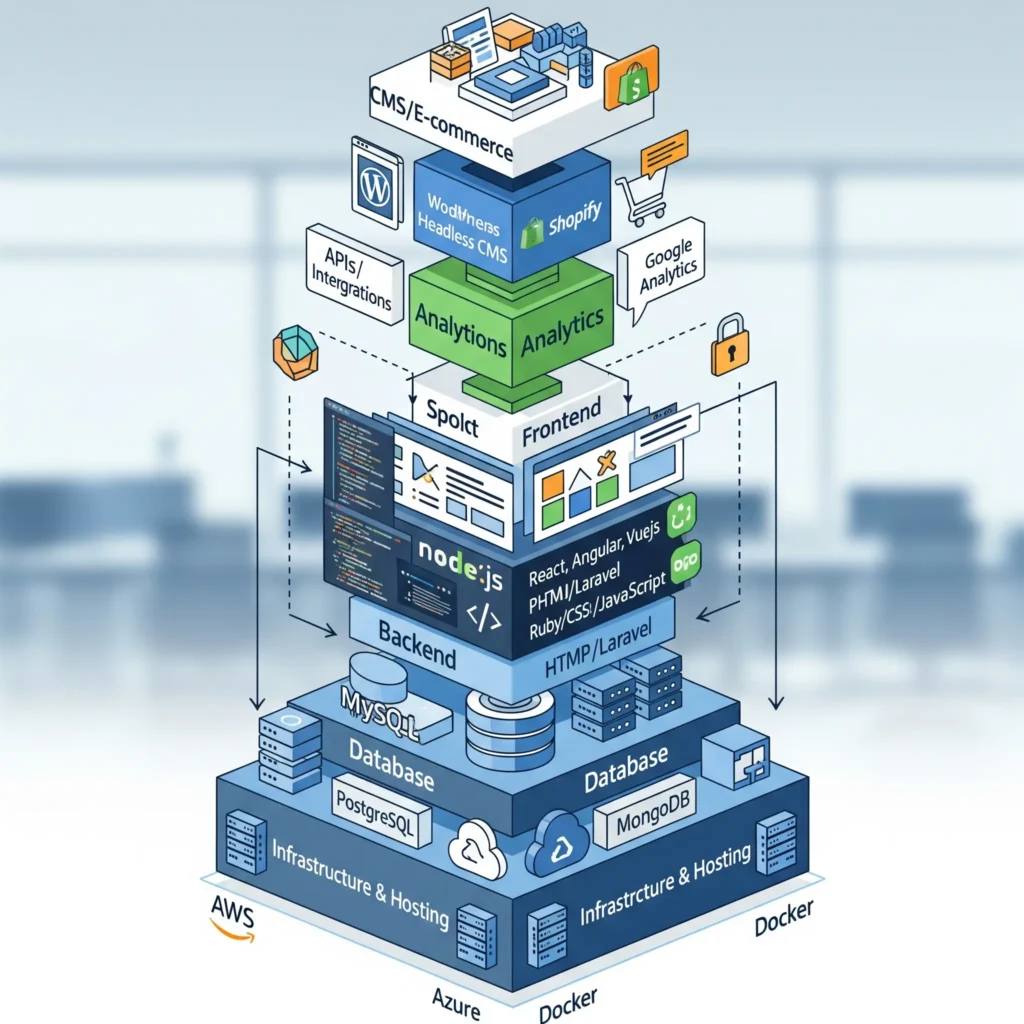
Your tech stack is simply the collection of technologies that power your website – from what visitors see (the frontend) to what happens behind the scenes (the backend) to where all your data lives (the database).
The bottom line? The right tech stack can make your website faster, more secure, easier to maintain, and cheaper to run. The wrong one? Well, let’s just say we’ve seen businesses spend tens of thousands fixing preventable problems.
The Frontend: What Your Customers Actually See
React: The Swiss Army Knife
Best for: E-commerce sites, web applications, businesses planning rapid growth
React is like having a really smart assistant who can handle complex tasks while staying organized. It’s what Facebook uses (they created it), and it’s perfect if you need a website that feels more like an app – think smooth interactions, instant updates, and the ability to handle lots of user activity without breaking a sweat.
Real talk: Your customers will notice faster page interactions and seamless user experiences. Perfect for businesses that need features like real-time chat, dynamic product filtering, or user dashboards.
Vue: The Friendly Newcomer
Best for: Small to medium businesses, startups, rapid prototyping
Vue is like React’s approachable cousin – easier to learn, faster to develop with, but still powerful enough for serious business needs. It’s gaining massive popularity because developers love working with it, which means faster development and lower costs for you.
Why it matters: Quicker development time = lower costs and faster time to market. Great choice if you want modern functionality without the complexity.
WordPress (Still Relevant!)
Best for: Content-heavy sites, blogs, businesses wanting easy content management
Before you roll your eyes – WordPress powers 40% of the internet for good reasons. Modern WordPress isn’t your grandfather’s blogging platform. With headless WordPress setups, you get the content management ease your team loves with the performance your customers demand.
Perfect if: Your team needs to update content regularly without calling your developer every time.
The Backend: The Engine Under the Hood
Node.js: Speed Demon
Best for: Real-time applications, APIs, JavaScript-heavy frontends
Node.js is like having a race car engine – built for speed and handling lots of simultaneous users. If your website needs to handle real-time features (live chat, notifications, collaborative tools), Node.js is your friend.
Business benefit: Can handle thousands of users simultaneously without slowing down. Great for scaling businesses.
Python (Django/Flask): The Reliable Workhorse
Best for: Data-heavy applications, complex business logic, AI integration
Python is like a reliable pickup truck – not the flashiest, but it gets the job done reliably every time. It’s excellent for businesses that need to process lots of data, integrate with AI tools, or have complex backend requirements.
Why choose it: Extensive library ecosystem means faster development of complex features. Perfect for fintech, healthcare, or data-driven businesses.
PHP (Laravel): The Practical Choice
Best for: Traditional websites, content management, budget-conscious projects
PHP might not be trendy, but it’s like a Honda Civic – reliable, cost-effective, and gets you where you need to go. Modern PHP frameworks like Laravel are sophisticated and secure.
Bottom line: Lower development costs, huge developer pool, and proven track record for business websites.
Database Decisions: Where Your Data Lives
PostgreSQL: The Smart Choice
Perfect for businesses that value data integrity and plan to grow. It’s like having a really organized filing system that never loses anything and can handle massive amounts of information.
MongoDB: The Flexible Option
Great for businesses with rapidly changing data needs or those building modern applications. Think of it as a adaptable storage system that grows with your business.
MySQL: The Tried and True
The Honda Civic of databases – reliable, well-supported, and cost-effective. Perfect for most traditional business websites.
Real-World Scenarios: What Works for Different Businesses
The Local Restaurant Chain
Challenge: Multiple locations, online ordering, frequent menu updates Our Recommendation: WordPress frontend with custom ordering system, Node.js backend for real-time order processing Why: Easy content management for staff, robust ordering system, room for growth
The Growing SaaS Startup
Challenge: Complex user dashboard, real-time data, need to scale quickly Our Recommendation: React frontend, Node.js backend, PostgreSQL database Why: Can handle complex user interactions, scales with growth, modern user experience
The Professional Services Firm
Challenge: Lead generation, content marketing, easy updates Our Recommendation: Modern WordPress with performance optimization Why: Team can manage content easily, great for SEO, cost-effective
The E-commerce Business
Challenge: Product catalog, payment processing, inventory management Our Recommendation: React frontend, Python backend, PostgreSQL database Why: Smooth shopping experience, robust payment handling, detailed analytics
The Hidden Costs Nobody Talks About
Maintenance and Updates
WordPress: Regular updates needed, but usually simple Custom Applications: More complex updates, but more control Budget Impact: Plan for 15-20% of initial development cost annually
Developer Availability
Popular Technologies (React, Node.js): Large talent pool, competitive rates Niche Technologies: Harder to find developers, potentially higher costs Pro Tip: Stick with mainstream technologies unless you have specific needs
Hosting and Infrastructure
Simple Websites: $10-50/month Complex Applications: $100-500/month High-Traffic Sites: $500+ per month Remember: Cheap hosting often means slow websites and unhappy customers
Making the Decision: Your 5-Question Checklist
- How often will you update content?
- Daily/Weekly → Consider WordPress or headless CMS
- Monthly/Rarely → Custom solution might be fine
- What’s your expected traffic in Year 1? Year 3?
- Under 10K visitors/month → Almost any stack works
- 50K+ visitors/month → Focus on performance-oriented choices
- Do you need real-time features?
- Live chat, notifications, collaboration → Node.js recommended
- Static content → Simpler solutions work fine
- What’s your total budget (including maintenance)?
- Under $15K → WordPress or simple custom solution
- $15K-50K → Full custom application possible
- $50K+ → Enterprise-level solutions available
- How technical is your team?
- Non-technical → Prioritize ease of use (WordPress)
- Technical → More complex solutions possible
Red Flags: When to Run Away
❌ Any developer who says: “This is the only way to build websites” ❌ Choosing technology because it’s “trendy” without considering your needs ❌ Ignoring mobile performance in technology decisions ❌ Not discussing long-term maintenance upfront ❌ One-size-fits-all recommendations without understanding your business
The Future-Proofing Factor
The best tech stack for 2025 isn’t necessarily the newest or flashiest – it’s the one that:
- Solves your current problems efficiently
- Can grow with your business
- Has a strong community and long-term support
- Fits your team’s capabilities and budget
- Provides a great user experience
What This Means for Your Business
Choosing the right tech stack isn’t about picking the “best” technology – it’s about picking the best technology for your specific situation. A small local business doesn’t need the same robust infrastructure as a rapidly scaling startup, just like a Ferrari isn’t the right choice for a family road trip.
The key is working with developers who ask the right questions about your business goals, growth plans, and team capabilities before making technology recommendations.
Ready to make the right choice for your business? Let’s have a conversation about your specific needs and goals. We’ll help you navigate these decisions without the technical overwhelm.
